


Archive for February 2007
Meet Ichimame
 Ichimame enjoying the plum blossoms of Kitano Tenmangu shrine, in full bloom just in time for the Plum Festival (Baikasai) thanks to the unusually warm weather.
If you are a geisha enthusiast like myself, chances are you already know Ichimame, the beautiful young maiko blogging away from her okiya in Kamishichiken, Kyoto's oldest and most traditional hanamachi (literally 'flower town', where geisha live and entertain). I first saw Ichimame perform last spring, when a wonderful series of unforeseeable events resulted in a free front row seat to Kitano Odori (the spring dance of Kamishichiken), convieniently positioned directly infront of her. At the end of the show, she smiled down at me, tossing one of her signed handkerchieves into my lap.
When I first discovered Ichimame's blog, I was so excited I wanted to post a link to it here. Being written completely in the Kyoto dialect of Japanese, I figured very few people would be able to read it and so decided against it. Thanks to the incredible number of visitors her site has been recieving from all around the world, she has begun a professionally translated English version of the blog, although it seems to be slow going. I wish I could volunteer to do it for her! I'd have that smack updated post haste! Until they get caught up, I'll post my own translation of the most recent entries here:
Starting tomorrow! Must sleep...

Geisha: Disney Style
Geisha dressed up as Princess Arora, Snow White and Cinderella for their Setsubun engagements. Thanks to my friend for hooking me up with this picture to share with all of you! m(- -)m

Twilight in Gion

A beautiful, first year maiko ready to cross the street on the corner of Shijo and the Hanamikouji.
 Another first year maiko weaving in and out of traffic and tourists on her way to the evening's first appointment.
 Ayakazu, now in her second year ,adjusts the long, flowing sleeves of her kimono as she heads off to work for the evening. A shikomi, or apprentice maiko, carries her bag for her. Note the traditional "Stich" handbag accessory (*^o^*)
Operation Explore Gifu: Inuyama

Hakutei-Jo, the White Emperor Castle. With less than six months to go here in Japan, and a rather willing amiga de viaje, I've been trying to make the most of my weekends by exploring something other than Kyoto: Gifu, my home for the past three years.
Standing proudly on a small hill 40 meters above the banks of the Kiso River, Japan's oldest original wooden castle keeps watch over the now concrete-covered plains and slowly rising mountains to the north. Below, hidden in the Urakuen te
 a garden (so well so that we did not find it), is the Joan tea house, considered one of the finest of its kind (which, for some reason, was brought from Kyoto in the 70's). Bushido, the way of the warrior, and Sado, the way of tea, have always existed side by side. The great warrior Toyotomi Hideoshi, who unified Japan and brought an end to the warring states period, once said that a fine tea cup was worth more than his castle and all its men. Of course, he also forced his loyal retainer tea master to commit suicide. Luckily we don't have to choose the castle over the cup, or commit seppuku if we never find the teahouse. With a little planning and a few directibles (also known as directions to those who speak proper English) we can have our matcha and drink it too, with time left over to savor the soba.
I should start by saying that, I have been extremely spoiled. The first Japanese castle I ever laid eyes on was Himeji, the king of Japanese castles. Once you see Himeji, everything else is just kind of, well, maa-maa. What remains of Inuyama castle is small, as are the castle grounds, but a slow and slipperless climb up the steep, unequally spaced steps is well worth it!
Key word being "slipperless".

 Gifu: A River Runs Through It. The Kiso River, that is. From the wrap-around balcony of the main tower, you can see it cut gracefully through the concrete covered plain as it makes its way to Ena (as seen in the picture of my beautiful mountain school: top right, under the page header).
 Abbey Sensei braces herself for the brutal winds from atop the tower. Fly away Abbey! Be free!
 Brilliant red torii (shinto's spiritual gateways) and crimson banners line the entrance to a small inari shrine at the foot of the castle.

Ema (from e:絵 meaning picture, and uma:馬, meaning horse) are small, colorfully decorated, wooden prayer plaques sold at shinto shrines for about 500 yen. After writing their wishes and prayers on the back, people hang them on racks in hopes that the kami (gods) will read them and grant their blessing. The pictures on the ema also have meaning. These were bought by junior high school students hoping for good scores on their high school entrance exams.
 Happy Chinese New Year everyone! Inoshishi: The Wild boar.
Handarari: Gion`s Soon to Be Maiko
 Meet two of Gion`s newest, soon-to-be Maiko. They are minarai ( 見習い ), apprentice maiko who have graduated from their study as a shikomi, the first step in becoming a maiko.Minarai means to watch and learn, and that is exactly what they do: they begin to dress and become accustomed to the full, formal regalia and make-up of the maiko, accompany their big sisters to ozashiki (banquets and parties where geiko entertain), watch, and learn, preparing them for their debut as maiko, when they will begin to entertain customers. It is during this time that their professional name will be decided, and announced at their debut.
Minarai look a lot like maiko, but their most easily recognizable trait is the length of their obi. Known as hadarari (半 han meaning half and darari refering to the long, flowing obi style of Kyoto`s maiko) a minari`s obi hangs to only half the length of that of a maiko.
 The long, trailing darari obi exclusive to Kyoto's maiko. The sight of a maiko's magnificent dangling obi swaying as she walks is supposedly one of the famous sights of Kyoto.
 Making their way down the Hanamikouji to the Ichiriki teahouse for their first engagement of the evening. I believe the young minarai on the right is from Okinawa, and was recently featured in a NHK documentary.
 The Ichiriki.
Happy Valentine's Day!

Here's to two things I love about Japan: Geiko and... Purikkura!
Obake
 Two geiko dressed as a town girl and man from the Edo period.
Risshun Setsubun, the parting of winter and spring, was traditionally somthing like a New Year's Eve and Halloween combined. To start the new year off right, Japanese people performed a number of rituals to cleanse the old year of evil and misfortune, and keep it away in the year to come. People even dressed up in costumes to trick the evil spirits into thinking they were someone, or something, else.
This tradition carries on in the hanamachi, or geiko districts, of Kyoto. Once a year, geisha dress up in costumes and entertain their customers as Disney Princesses, Playboy Bunnies, samurai...Whatever they wish.
 A feudal princess and samurai.
Remember Mamechika? Here she is as a geiko (purple kimono), enjoying Setsubun with her boombox (^-^)/

Geiko dressed in white wedding kimono.

More Scenes from Setsubun

The maiko of Gion Higashi, in order of rank: Masayo, Tsunemomo, Umeha, Kanoaki, Miharu.
 A priest summons the maiko of Gion Higashi (one of Kyoto's five hanamachi, or geiko entertainment districts) to the stage of Yasaka Shrine to be blessed before the mamemaki (bean-throwing) ceremony.
 Before the mamemaki ceremony, Gion's Taiko group takes the stage.
  Mission Mamemaki accomplished! The girls make their exit.
 The mix of ancient tradition and ultra-modern technology: This is Japan!
Masayo: Gion Higashi

Masayo, the highest ranking maiko of Gion Higashi (one of Kyoto's five geiko entertainment districts), wearing the special hanakanzashi (flowered hair ornament) for February. The plum blossoms celebrate the end of winter and the coming of spring.
Tsunemomo and "Drink-Driving"?
 Tsunemomo, Masayo, and the maiko of Gion Higashi descending from Yasaka Shrine after the Mamemaki (bean throwing) ceremony.
Japanese technology never ceases to amaze me, nor does unavoidable deterioration of even native English speaker's language skills after a prolonged stay in Japan-land. Case in point: The presumably foreign author's (Justin McCurry) repeated use of the term "Drink-Driving'". I, too, have been outside of my native English speaking habitat for quite a while, so perhaps I'm mistaken, but wouldn't the correct terms be "drinking and driving" or "drunk driving"? Does not "drink-driving" refer to actually driving a drink, as opposed to an automobile?
****UPDATE****
Drink-Driving is a perfectly correct term used in England. I apologize if I offended anyone. m(- -)m
"Motorists who flout the law by driving home after a few drinks will soon be up against a formidable foe: their cars.
Toyota is working on a system of sensors that will automatically shut down a car's engine if it thinks the person behind the wheel has had too much to drink.
Cars will use sensors on the steering wheel to measure the alcohol level in the river's sweat, the Asahi Shimbun newspaper reported. If it is too high the car will not start."
You can read the rest of the article here.


"Oni Wa Soto! Fuku Wa Uchi!"

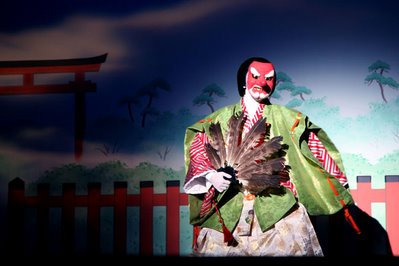
The Long-Nosed Goblin of Mt. Atago: Performed by the geiko of Gion Higashi. During setsubun, many people hang Okame masks (thought to bring good luck), like the one above.
 A long-nose oni (goblin, devil) mask.
As in China, the celebrations were not without their hideously evil creatures. The devilish Oni were originally invisible spirits or gods which caused disasters, disease, and other general unpleasantness in the lives of humans, taking on a variety of forms to deceive (and often devour) them. The Chinese character (鬼) meaning "ghost" came to be used for these formless creatures. It was not until Buddhism arrived that Oni took on its present ogre-like form.
I'm off to Kyoto to experience mamemaki myself! Happy Setsubun! Fuyu was soto! Haru was Uchi! (Out with winter! In with Spring!)


Ichimame's Blog: English Updates (^-^)/
Hanakanzashi (Flowered Hair Ornaments): February
The ofuku hairstyle's hanakanzashi (the hairstlye that [Ichimame is] currently wearing) consists of large plum blossoms. As for me, this plum hanakanzashi is one of my favorites. My hair has been styled in the ofuku style since last autumn, so I am looking forward to wearing many different kinds of hanakanzashi from now on.
The Plum Blossom Festival
The people who do us the pleasure of coming every year said "It's good that this year is warm, isin't it?" I hope next year is warm, too.
Tenjin-san's (Kitano Tenmango Shrine's) plum blossoms are this much in bloom.