


A Stroll Through Miyagawa-cho
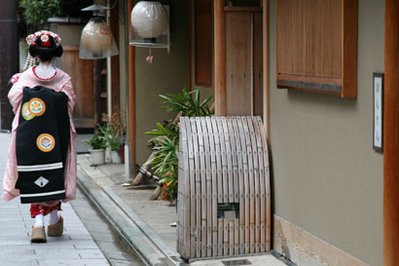 With October drawing to an end, I was determined to make a quick trek to Kyoto to secure tickets for Gion Odori, Gion Higashi's fall dance recital. I hadn't been to Kyoto since Gion Matsuri, and after three months I was itching for an excuse to get back.
Kyoto, like the rest of Japan, has been burried beneath a net of tangled electrical wires and encased in concrete. As I pulled into the station, staring out the smudged windows of the train, I wondered how I would have felt if this had been my first view of the old capital. Many foreigners must feel extrememly disappointed upon arriving in Kyoto, expecting to find old Japan, untouched by the rapid westernization consuming the world. Yet it is in the cracks and crevices of this seemingly cold, colorless, modern metropolis that the wonders of the ancient capital strive to survive, and wait to be discovered.
Kyoto has been my home away from home (away from home) since the first time I stumbled up the stairs of the Shijo Keihan subway station (after being stopped by a tiny little Buddhist nun who smiled and bowed and pinched my nose saying "Kawaii ne! Hana takai ne!" (Well aren't you cute? And your nose is so high!), and out onto the busy street, lined on one side by the Kamogawa River and the famous Minamiza Kabuki Theatre on the other. I know it better than the city I have been living in these past 2 and a half years, and probably know more about it than my hometown in the US. So as I weaved my way through the traffic of Japanese tourists filling crowded Kyoto station, I felt strangely enough as if I was home.
I walked along the Kamogawa River, wondering where the day would lead me. I always follow the river up to a certain point before loosing myself in the narrow lanes of Miyagawa-cho, one of Kyoto's five flower districts, where geiko live and entertain. I never expect to see much during the daytime-- perhaps a young maiko on the way to her lessons, casually dressed in a simple kimono-- but just walking through the quiet streets, lined with intricate wooden facades of ochayas (teahouses) and okiyas (where geiko live) is more than enough to make me happy. If I'm lucky, I'll hear an older geisha singing as she practices her shamisen, or see a maiko dressed for an appointment hurry into a taxi or down a narrow alleyway. These simple moments, when I am able to see my life in the light of a haiku, are what keep me madly in love with Kyoto.
The streets seemed quiet enough. It was still early, before noon, and little old women were washing down the concrete in front of their homes. The old man from the tiny little home-front market hurried back and forth across the street carrying big boxes of perssimons and apples, shouting out "Ookini!" to someone hidden in the shadows of his little shop. My eyes focused on the nameplates hung near the entrance of the okiyas, trying to decipher the kanji in the names of the maiko and geiko living there, until a sudden flash of intense color in the otherwise dull distance caught my eye. A maiko sliding out of her okiya and down the street, her long, trailing obi fluttering above her high wooden sandals, appeared like an apparition from another age. "What a great way to start the day," I thought as I watched her disappear into another teahouse, smiling to myself, happy to be "home".


Meeting the Maiko of Miyagawa
Goro goro goro goro... The unmistakeable sound of a wooden door sliding open. Whenever I find myself strolling through a hanamachi (flower town, where geiko live and entertain), my senses are heightened and alert. Even simple sounds that usually blend into the indistiguishable hum of everday life in Japan, become melodious, distinct, and full of meaning.
"Konnichiwa," I smiled back with a little bow.
"Kawaii, ne? Nihon no maiko-san..." (Cute, aren't they? Japan's maiko)?
"So cute! Beautiful! They're like living works of art. Their hair, their kimono, their make-up, and the way they move... Like a dream!"
"Yes, but it's very difficult, you know. They come from very far away and study very hard. And how about you? You've come quite a way haven't you? Where are you from?"
"America. The State of Ohio. Ohaiyo!" I smiled cheesily and waved my hands in typical school girl fashion (Ohaiyo means 'good morning/ hello' in Japanese).
"Oh, really? Ohio." She said as she laughed at me. "You know, my big sister went to America before. Oh, if she was home I bet she'd love to talk to you. Are you a student? Are you studying abroad? How amazing that you can speak Japanese so well! It's amazing!"
"Actually, I'm an English teacher in Gifu prefecture," I giggled. I get the student thing a lot (I'm not complaining)! "And my Japanese is horrible! I don't study at all...But Thank you for saying so." We stood in the street talking for quite awhile, and eventually she mention that she was 80 years old. 80 years old?! The woman did not look at day over 60, and a young sixty at that. Now that is amazing. It got me thinking, just how old was her big sister?
As we stood in the street, maiko continued to hurry by. Incapable of hiding my excitement, I fumbled akwardly to get my camera untangled from my neck and bag before they hurried past us. "Oh, that's good!" She said. "We'll take a picture!"
"What? No, no, that's Ok! They're busy and..."
Before I could refuse she was already calling to Yasuha, by name. To my suprise, Yasuha greeted her with a big smile, a bow and bubbley "Konnichiwa Okaasaan!" The little old woman asked her if she could take our picture, directed Yasuha to stand in front of a teahouse across the street, and pushed me over to her as she grabbed my camera out of my hands.
I apologized and thanked Yasuha about 3 times in one breath, even as I tried to smile for the picture. "Hai cheeezu!" She called out. "Ah! That one was no good. One more! Hai Cheezu! Ok!"
I started to apologize and thank Yasuha all over again, but she smiled, bowed to me, said "Ookini" (thank you in Kyoto dialect).
As Yasuha walked up the street, a little old woman leaning on her cane came around the corner. Yasuha greeted her and bowed, stopping in her steps and turning to face the old woman as she slowly hobbled on by. "Oh! Here she is! This is my big sister. Big sister! This cute little sister is from America! It's amazing. She can speak English and Japanese!"
The big sister, who turned out to be 84, slowly made her way to me with a beautiful smile spread across her softly wrinkled face. She asked me where I was from and if I was a student, and then we began to talk about her trips to America at least 40 years ago. She had been to L.A., San Fransisco, Las Vegas and the Grand Canyon. "It was amazing. I had never seen so many fruits. Such beautiful fruit!"
"Really?" I asked "Was the fruit delicious?"
"Oh, I don't know...I never got to eat any. I was with a customer. You know we can't eat when we're with a customer like that. But I remember thinking, "What beautiful fruit!" I had never seen anything like that before!"
The maiko were still making there way back and forth, calling at okiyas and hurrying to get to the recital practice. All of them greeted this wonderful little woman with deep bows of respect and sweet sounding "Konnichiwa Okaasaan!" and then would smile at me a give a little bow. She often asked them to stop for me to take a picture, or tried to talk to them long enough until I seemed satisfied with the shot I had. "Did you get it?" She asked when they would clop clop away down the little alley just next to her home.